the echo hunter
On vibrations, echos, and how to find authenticity.

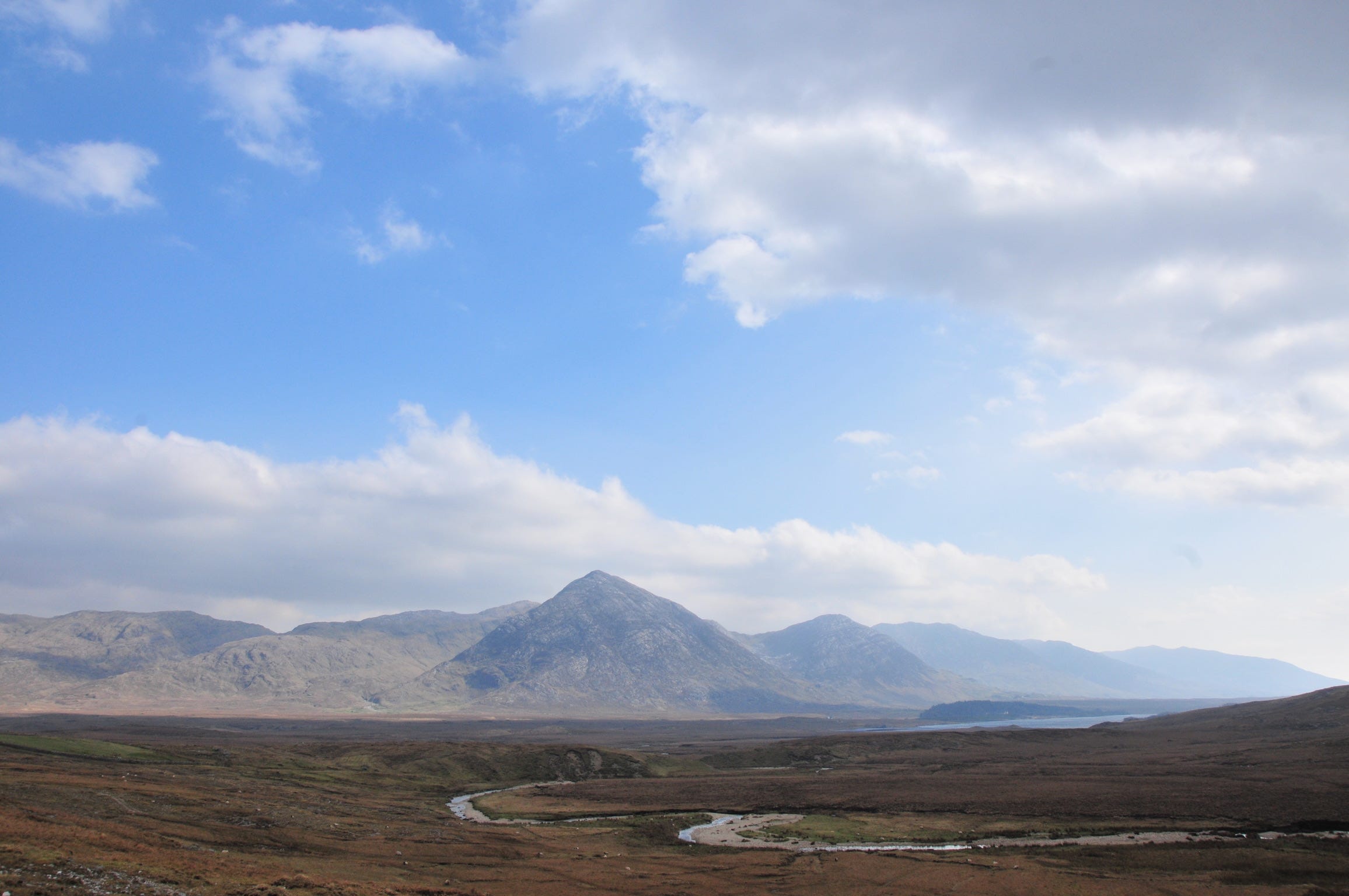
I met a map-maker once, years ago, on the west coast of Ireland. He was not like other people I had met, he seemed like a monk to me, and it felt comfortable as I had just finished studying philosophy for a few years in university, and monks, mapmakers, and philosophers can share dispositions. We would sit and talk and drink tea in his office, a light infused room at the end of a pier in the village of Roundstone; and I knew it was special.
Tim was originally from Yorkshire, a mathematician, at first, then, a successful artist in a time when geometric figures were in trend; there are pieces of his at the Tate Modern and he went by the name Timothy Drever then, later returning to his full name, Timothy Drever Robinson. A mathematician’s mind creating beautiful scenes from fractal geometries. A life of seemingly large shifts but all on theme with mathematics, beauty, and chaos. Then, in another shift, he picked up and moved off the coast of Galway to the Aran islands. It was 1972. There he found the merging of his worlds on the shores of rock, swirling coastal lines constantly shifting with the waves and the tides. His mind wanted to know more about the landscape and he searched for maps. He found the most accurate maps made were Ordnance surveys that had been drawn by an institution not familiar with the way of Irish topography, and were last updated in the early 1900’s. The maps had anglicised versions of names which carried no weight of meaning to them, no context, white noise; zero of information-content. Robinson wrote “Irish place names dry out when anglicised, like twigs snapped off from the tree,” and he became interested in mapping the landscape with all the complexities of personal history of a community. This was no easy task as he was not from there, but ever committed, Tim started to walk, and talk, and mostly listen and then began marking notes on a page. It became a new art piece that was to last over 40 years. He produced hand drawn maps of the Aran Isles, the Burren, and Connemara; but single map sheets not being enough to tell the stories of the places, he also wrote page after page about the mapping and stories of the landscape, translating what he was hearing in the homes and pubs of the countryside. These writings became a series of books on the region; two books on the Aran Islands, and three on Connemara. Together with the physical maps he drew, one would have the topography as well as the context of communal history. Tim’s writing was an attempt to lock in the language of the place in the naming of things. Place names locals used were beginning to be lost, and in the names were the understanding of time and space of the landscape. In the words were the landscape itself in the timbre and tempo.
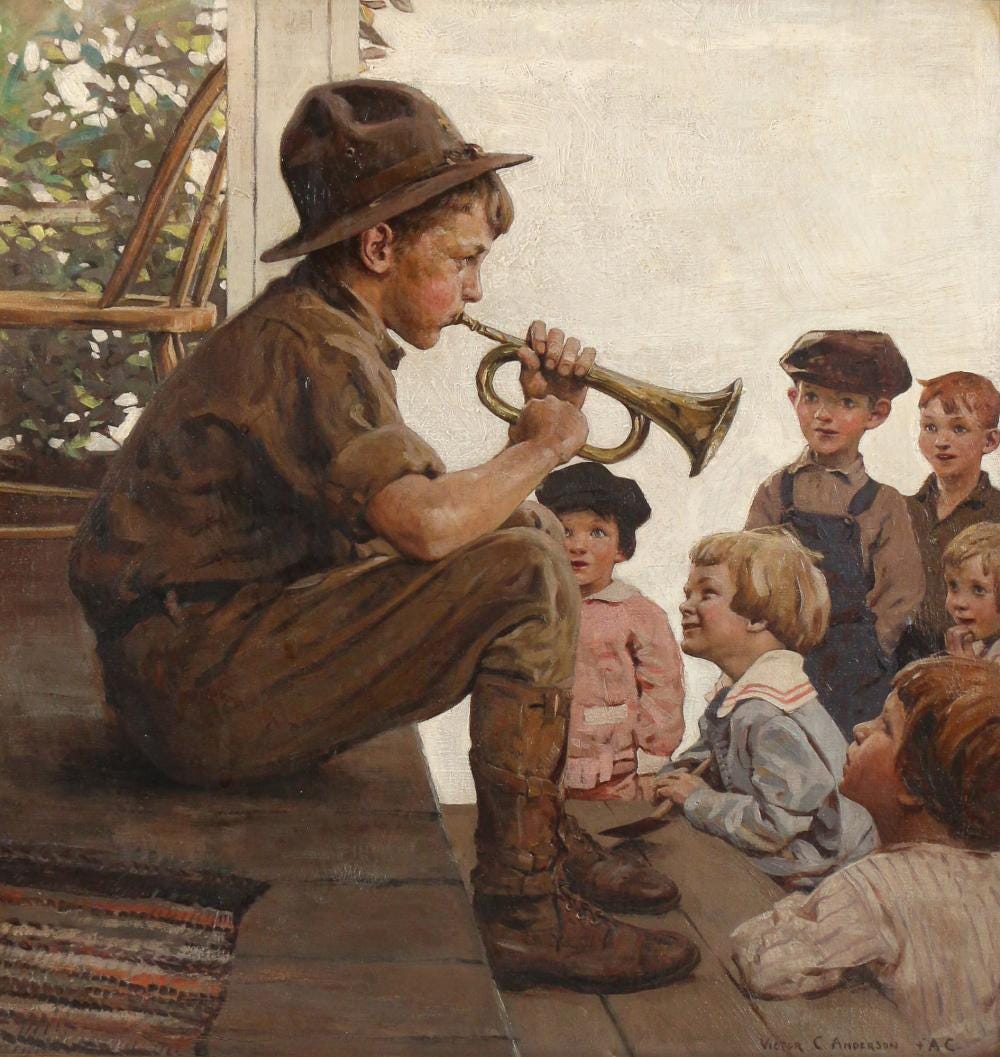
Tim once told me a story of an echo and it stuck inside my head and sits there still. It is a story he dug up from an old book he found in a London Library, a pastime we both shared, the browsing of bookstalls and jumble sales. The book was The Saxon in Ireland by John Hervey Ashworth, published in 1851. This section of the book was titled The Echo Hunter and it told the story of a real estate businessman, while traveling in Ireland, encounters a peculiar gentleman musician who plays the bugle, not for its own music, but to “awaken” nature through echoes amongst mountains and valleys.
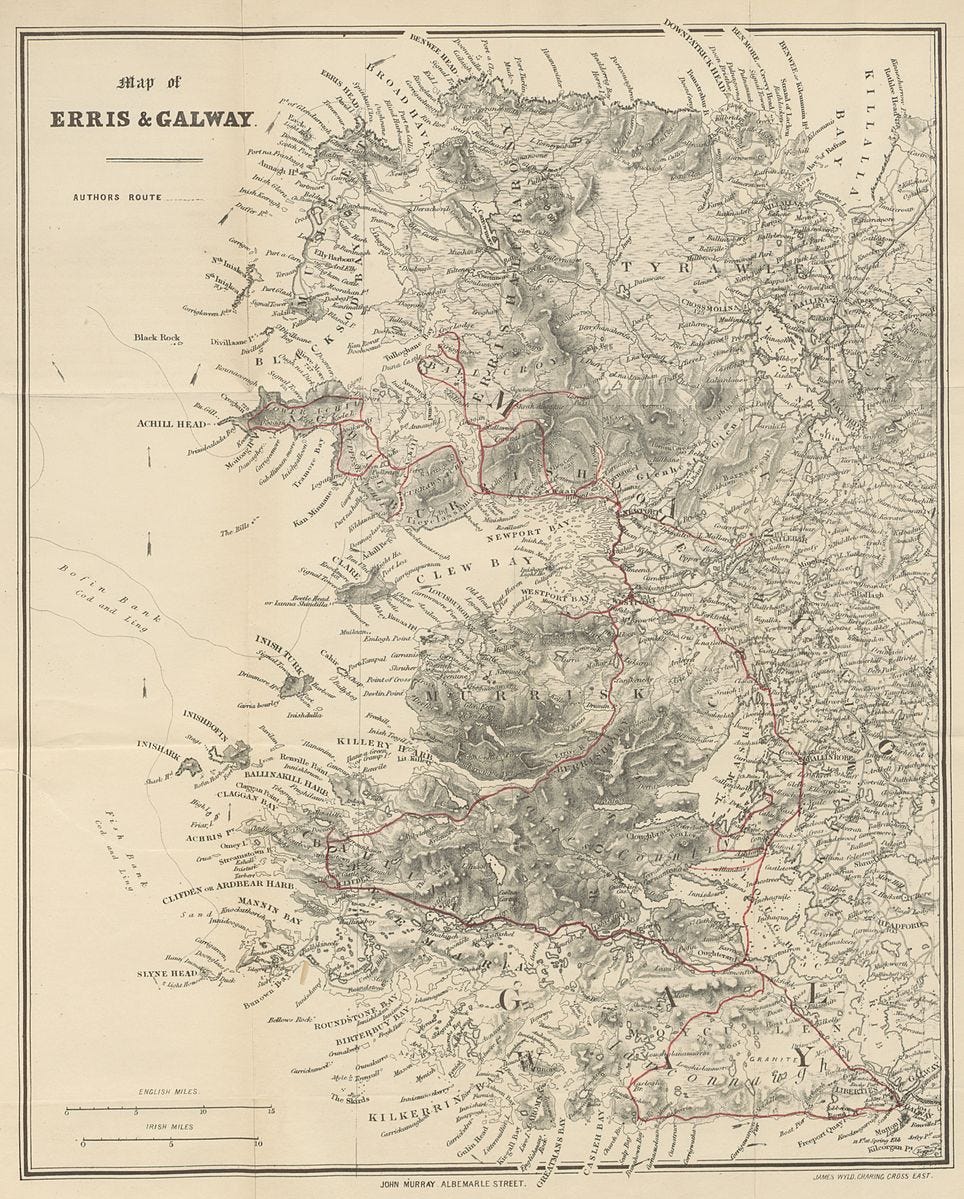
“I use this bugle to awaken Nature, whom you will find sleeping among the crags and cliffs. The moment I sound my bugle, an answer comes from the mountains, no less singular than it is beautiful—leaping from rock to rock, now loud, now murmuring, but always sweet, till it dies away in echoes, low and fine as the gentlest wailings of an infant.”
The man, deeply devoted to this pursuit, claims to have discovered special places across Ireland, Wales, and Scotland where echoes answer his call with extraordinary, almost supernatural beauty. He chronicled the best Echos in the lands.
The narrator is then invited to accompany the echo hunter into the Ballycroy mountains, where he experiences a breathtaking performance:
“ To describe it is impossible. No band of instrumental music in the world could equal it. The reverberations were perfectly astounding. The rocks and mountains seemed alive with the soul of harmony; the softest and wildest notes floated on the air—now close, now distant; now dying away in some distant recess of the valley, now awakening louder and louder among the cliffs and precipices; at one moment faint as the whisper of the breeze, at another loud, clear, and bold as the trumpet of the Archangel.”
The description of the echo spot was communicated through local names, three old Irish names of particular mountains and valleys. “in Ballycroy, near the lake of Carreg-a-biniogh, and in a spot between Corselieve and Nephin Beg mountains, he had awakened, he said, responses that might almost be thought superhuman.”
All three places I knew, not for echoes, but from past experience exploring the region, I lived a few seasons in Ireland and have guided there for years. I was set to be heading back to Ireland on a trip and on the way I would pass by the Corselieve and Nephin Beg mountains so a seed was planted and I knew I had to seek out a bugle.
I played trumpet in my high school marching band, in a town that had a relationship with football akin to “Friday Night Lights.” Every gameday in the small Georgia town we would march at halftime and play. We would play in the stands during the game. We would practice in the summer southern heat and in the off season we would call ourselves an orchestra and play in competitions. All is to say I had muscle memory and embouchure. It couldn’t be any bugle, it had to have a feel, a history, so I spent off hours looking through estate sales and antique musical instrument sights until I found one in a second hand store in Toronto. A bugle old with patina and dents, made by R.S. Williams and sons in Ontario in 1916. The bugle had been to the war and back and seemed to have enough mojo in it to help find echos in Ireland so I bought it and across the Atlantic it was to go once more.
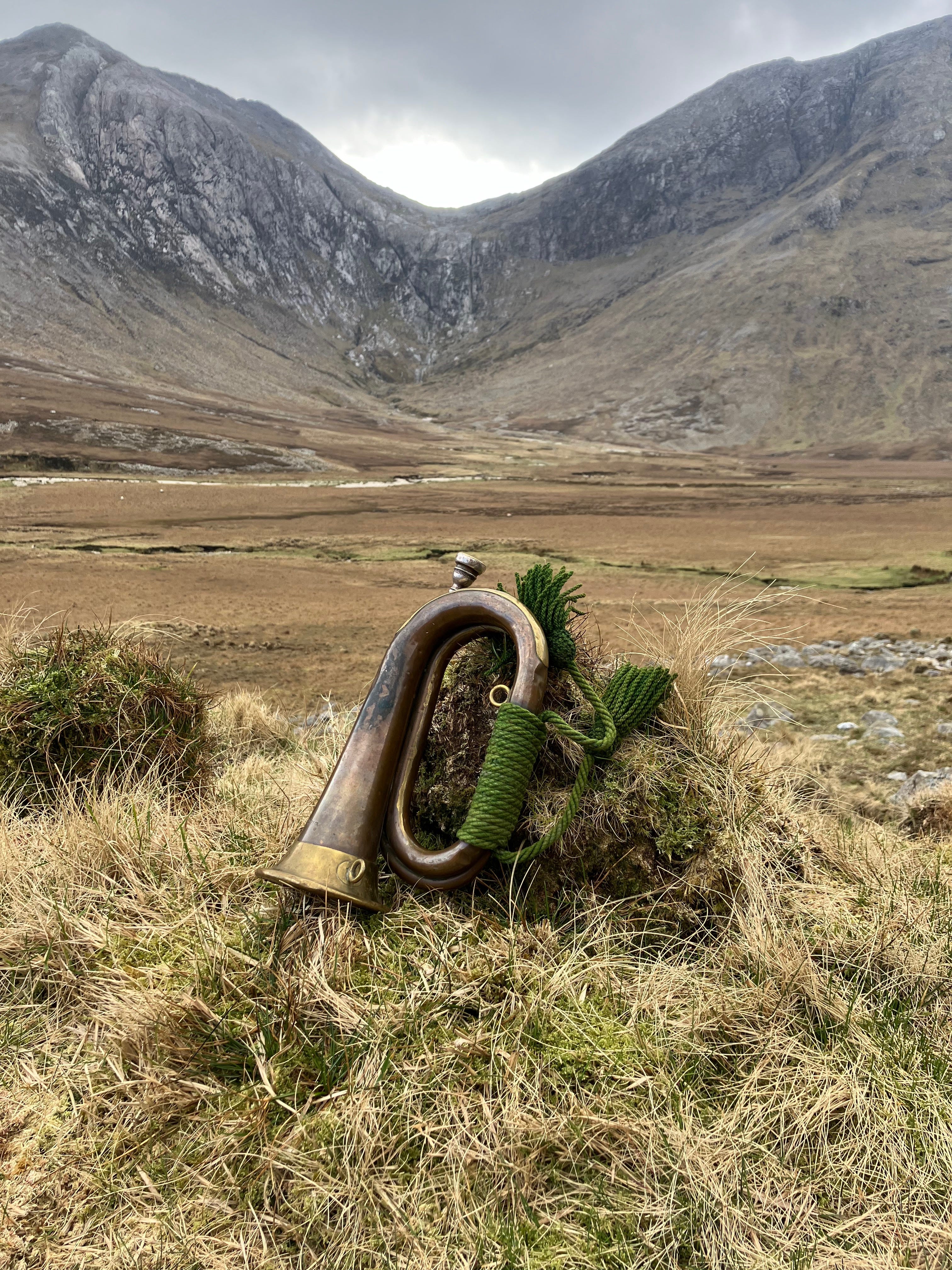
It is not out of place, sadly, to walk with a phone in hand, head turned downward encased in an alternate world as you experiance a new city. Back packs and fanny packs, umbrellas, walking sticks, all things known to be carried while out and about. Bringing an old bugle with me on the trip to dedicate a bit of time for the searching of echos in the landscape I found poetic, and it is, but I quickly realized it was also a magic portal with people, it is a strange sight to see so people poke and prod. Someone would see this thing strapped to my back, or on a table in a pub or cafe and would ask things. This is a place that is no stranger to people carrying around instruments, this is a land of buskers and performers, singers and poets, but something about a bugle sets it out of place, its limitation of song only being able to play overtones, it begs questioning. And once asked the idea of echos would take over surpassing the interest in the bugle. In that way the bugle was a key, it opened up memory, for how many of us recall echoes in our youth and their strangeness. So many I talked with would open up with places they knew from childhood and they would send me down streets and valleys and out into pastures with them to find old echoes of their memory. There was one particular valley I remember after talking with friends who ran a hotel close by, a place in a region I knew very well and lived in for a while many years ago, but for some reason I had never gone up into this one small offshoot valley. It shook me, and while I walked up the valley it felt electric and technicolor. It didn’t feel like Ireland, it felt like Himalayan peaks or a large cathedral, I felt small and sublime, like I was just a few inches off the earth.
When I was a child I learned that if you sang a certain note in a bathtub the room would vibrate and hum. Only certain notes would work for certain places, as if the room held its own chord. I taught this to my kids and I hear them now from time to time trying to find the note in the shower, the one that makes the room buzz.
In the springtime in Ontario you can find large swarms of gnats that hover in sun spots, and when you sing different notes the swarm moves and changes shape depending on the song, the tune, the note. The males have special organs at the base of their antennae that can detect wing frequency; the vibrations of the female’s wing. When we sing or whistle, and if we hit the right notes, the swarm will move as if called or directed. The group becomes fluid in motion, coordinated through lateral vibrations of song. Birds and insects navigate through vibrations and reverberations. When an animal of prey moves in the woods, small mammals release distress pheromones. These trigger silence in birds and insects, they stop moving to save themselves, they stop vibrating and a silence is measurable.
We respond to vibrations. You can feel this when we pray, utter words from mouths to send it outward from the body, and sometimes we do this collectively through song and dance, which can glue a room together, or when someone gives a speech that makes you rise.
Language is a way of organizing vibrations to transmit ideas; a wavelength mapping of concepts we can push out with breath and wind, and there are many different languages outside of words. I have sat in temples with monks beating drums chanting incantations I did not understand but felt. I have stood with the choir and cried by the songs we sang.
A few winters ago I was standing in a modest kitchen room in the west end of Toronto that should not have been able to, but probably held about 60 people, all with voices raised, drinks in hand, singing in unison, in an act called wassailing. Pagan roots with harvest rituals, wassailing is an act of celebration usually held on the 12th night of Christmas, the eve of the Epiphany. This isn’t a religious ceremony though, it is a party, it is like bacchanalia or carnival or Mardi Gras, and is related to each of those in different ways. It is a ceremonial party with old roots. The room vibrated to each note sung, the rafters slightly shook, and all undulated. It was religious, some cried whilst singing, not for the lyrics, but simply because of the act, the connective vibrations. It was beautiful (a recording of us singing is below). I know this sounds out-there and fictional, but there are literal connections happening in these moments, notes in harmony, entwined, connected to throats and vocal chords, to chests and heart beats. There is science to this. In collective spaces like live music shows, or parades, or church, participants heart rates, cortisol, breathing patterns, all start to meld together into one collective rhythm. Groups of people measured prior to events like this all have separate measurements of cortisol levels, heart rates, etc, and after a concert, a march, some sort of collective human celebration, all of these measurements are in sync. We can feel this exultation, and have felt it, more in our youth when we spend more time unconsciously seeking it out, at a concert, listening to the great speech makers, our neurological systems start to affect each other. It is what the poets call awe.
Light moves by vibration as well, in waves. I have looked into an others eyes and communicated with light and color, we all have, we can sense love and fear and joy all through those echos.
Echos can move not just in vibration but emotion. The strangeness we notice as children when we first hear an echo is not out of inexperience, echos are strange, like vibration mirrors, reminding us that matter sings, and that the physical world is not what we think it might be. On the quantum level, the building blocks of all landscape and all matter is made up of nothing but vibration; electrons pulsing and moving sending waves in a strangeness we still don’t fully understand.
I feel like there are analogies here to travel, that beautiful act of moving around our spinning sphere, talking with each other, and connecting. We echo, we mirror, we vibrate and pulse, we map and relate, we shine.
In letting an echo drive, it led me to parts of the country I never would have seen, conversations with people I never would have met, far from the bus tours and four-leaf-clover hats. It opened up new conversations with people and allowed for a way to connect that wasn’t consumptive or dealing with capital, instead it was human and curious, an exchange of story instead of goods, an exchange of echos. The good journalists know this way well, this isn’t a new idea. You need a doorway into understanding, a conduit, a bugle. Trust your impulses and they will lead you. Seek out your own sort of echos and they will give you the perspective of place you have been wanting, the authenticity we all seek.