

bones and curiosities
On the birth of the Gobi Dinosaur Museum and the passions of Bolor Minjin.

I went to Washington DC in early spring a few years ago. It was for a cocktail party in the Kennedy Caucus room of the Russell Senate building. Although originally intended for party caucuses, the size and grandeur of the room made it a likely site for major public hearings. The room served as a stage for some of the most dramatic Senate investigations, such as the sinking of the Titanic, the McCarthy hearings, and Watergate.
The cocktail party was in celebration of a project called Enduring Earth signing in an agreement with the government of Mongolia, The Nature Conservancy, The Pew Charitable Trusts, and the World Wildlife Fund; an economic package that will deliver USD 198 Million over the next 15 years in order to preserve and conserve 14.4 million hectares of grasslands, forests, deserts, wetlands, and rivers, as well as strengthen the management effectiveness of 47 million hectares of Mongolia’s network of protected areas (a chunk of land larger than the state of California). I had been involved in the process in a few minor ways and was invited to come, raise a glass, and join in celebration of the achievement.
It was that first day of Spring that really hits, especially north of the Carolinas, or perhaps it was especially noticeable to me as I was flying in from a still snow covered Toronto. It was warm in the day and walking the grass of the National Mall you could see snowdrops, hellebores, and crocuses starting to bloom. Cool in the evenings, a perfect season for sleeping with the window just cracked.
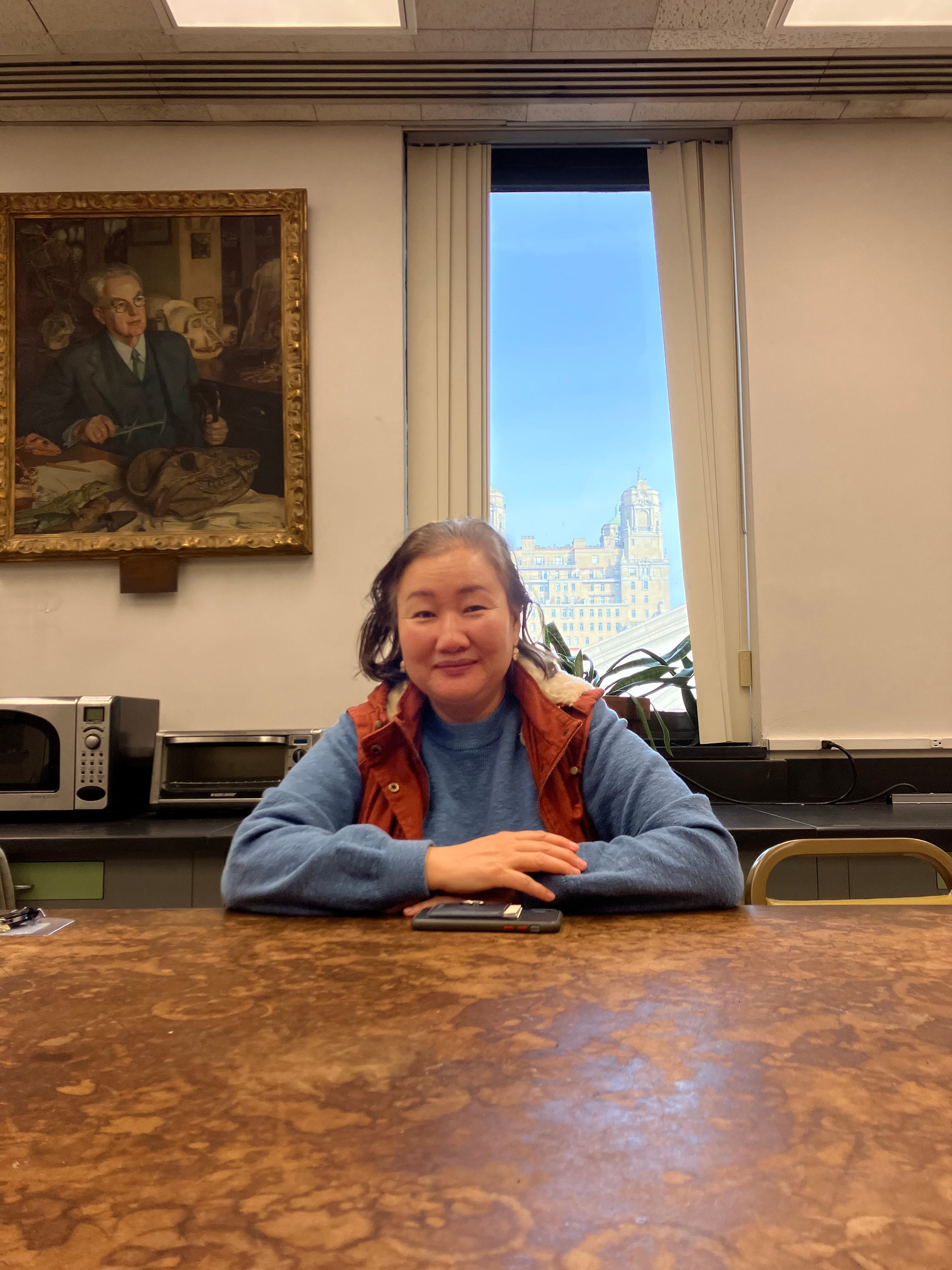
At the party I felt more like an observer than a guest; there were business leaders and politicians, as well as people deeply involved in Mongolia and its international workings. At some point I was introduced to a palaeontologist named Bolortsetseg Minjin (Bolor), Ph.D.: Executive director of the Institute for the study of Mongolian Dinosaurs, and was swept away into fascination. Bolor’s focus is on the protection of fossils in Mongolia and she works closely with the U.S. Department of Homeland Security to reveal illegal markets in Mongolian fossils. Since 1924, all Mongolian fossils have been considered property of the state. No private collecting was allowed, and no specimens were to have been taken from the country without special permission from the government. Despite this, fossils have been taken out in steady streams for years, and over the past 15 years real effort has begun to stamp out illicit trade. A few years back a skull of a Tarbosaurus bataar (a relative of the T-Rex) that had been poached from the Gobi Desert was sold at auction to Nicolas Cage. Bolor was the palaeontologist who identified the bones. Cage later voluntarily agreed to return it to the Mongolian government.
Bolor is involved with so many projects outside of this as well. Children’s education, Mobile museums, she works for the American Museum of Natural History (AMNH), she is a member of the Explorers Club in NYC, she is a National Geographic explorer. After the cocktail party that night I walked down from the Senate to my hotel just behind the White House, the Hay-Adams, a classic hotel that has windows you can still open. My mind raced and I knew I would keep in touch with Bolor and offer my help in any way I could, she does that, she is able to foster and inspire curiosity.
On the first day of Spring coming up in a week and a half I am flying south again, this time to New York City, to another cocktail party, this time to mark the start of something new, to help Bolor ignite a fire in the minds of those keen and able, at the Explorers Club in the upper east side. Below is an explanation of the context and the story of her dream coming to fruition. The spark that will become The Gobi Dinosaur Museum.
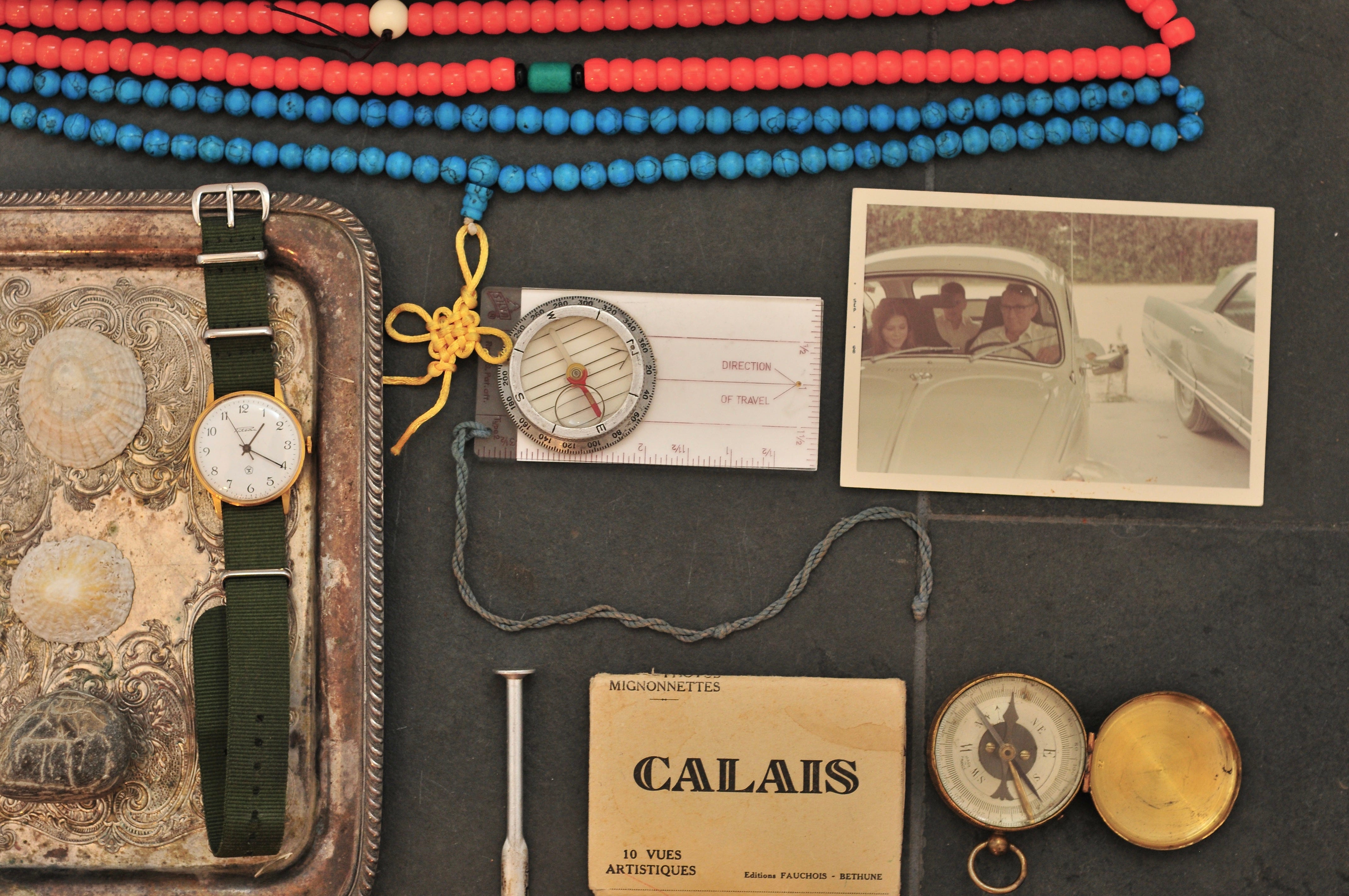
Humans have always collected things. There are ancient cave dwellings with shark teeth found that come from deserts thousands of miles away, things that were traded for inherent value. Greek muses were worshiped in houses called Museums (the particular entomology for this word being “house of muses”), places of inspiration.
In the Renaissance this word made a comeback but in the form first of small collections individuals would have from recent travels, small museums. They were stored in cabinets or small rooms and were called Cabinets of Curiosities, or Wunderkammer: wonder rooms. The concept of geology, of a world that shifts and moves and is not static, this idea is fairly new to us, an idea of ‘deep time.’ (The phrase “deep time” was coined by John McPhee in his 1981 book Basin and Range, by visualizing Earth’s 4.5-billion-year history as the span of a human arm. In this analogy, the history of the world begins at one shoulder, and a single swipe of a nail file on the middle finger removes all human existence.) In this mental framework mountains move and plates of the earth’s crust fold and morph like dough under the chefs hand; things once thought as locked and firm now fluid. In the 1830’s Charles Lydell published his Principles of Geology which sparked the imagination of many to look to rock and stone as a window to history instead of just rubble. It allowed for many to realize there were worlds of the earth’s history that no longer exist, and that we can see into those worlds through looking at rock and stone. It was the first time we realized extinction was possible, primarily through the work of French naturalist Georges Cuvier, that there were animals that ruled the land that no longer exist. Previous to this, fossils landed in the realm of myth and mistake, but there was a new science that explained it, and created a thirst for understanding, even the Queen of England had a mineralogist on call. The concept of the “Sublime” was written into thought by the Anglo-Irish philosopher Edmund Burke in his book A Philosophical Enquiry into the Origin of Our Ideas of the Sublime and Beautiful. This is the tide mark we can see where wilderness and mountains and oceans and deserts became beautiful, when we stopped fearing the snowy peaks and began to know the joy of feeling largeness and insignificance. In seeking out the sublime in mountains and caves we began to notice things like geology, plate tectonics, and fossils.
It was the trend for the wealthy to go on a trip and collect things, objects, art, artifacts, and fossils to bring and spark conversations and study in their wunderkammers back home. Some sort of shift was omni present in culture in these days, philosophy had changed and the idea of the new Sciences were emerging. You can see this in the writings of Francis Bacon and the idea of philosophy being about going out rather than sitting in a dark room engrossed in contemplation. A universal natural history and categorization. Travel was central to this new science, we must go out to get things and bring them back to study and look at. The frontispiece of Bacon’s book Novum Organum (1620) had, in Latin across the page: Multi pertransibunt & augebitur scientia (“Many shall go to and fro, and knowledge shall increase”), a quote itself from the Book of Daniel (12:4). Travel is linked with the success of the new sciences, with the wonder rooms, a going out must begin.
The grand tour was born from this, the gap year taken by the privileged where one would travel through Europe and the holy lands to bring back art and stories. A certain bacchanalia would happen as well, what happens on the grand tour, stays on the grand tour. The grand hotels of Europe were built to house this market, guide books were written to advise. As modern organized travel began, so too did the large museums of the world. The collections and Wunderkammers began to grow in size, and buildings were needed to house the curios. The Ashmolean Museum was a collection of Cabinets of Curiosities by Elias Ashmole donated to Oxford for the hope of study and knowledge. Something learned from the objects themselves. With objects brought back came ideas and influence; architecture, fashion, and music. The American Museum of Natural History was born through this.
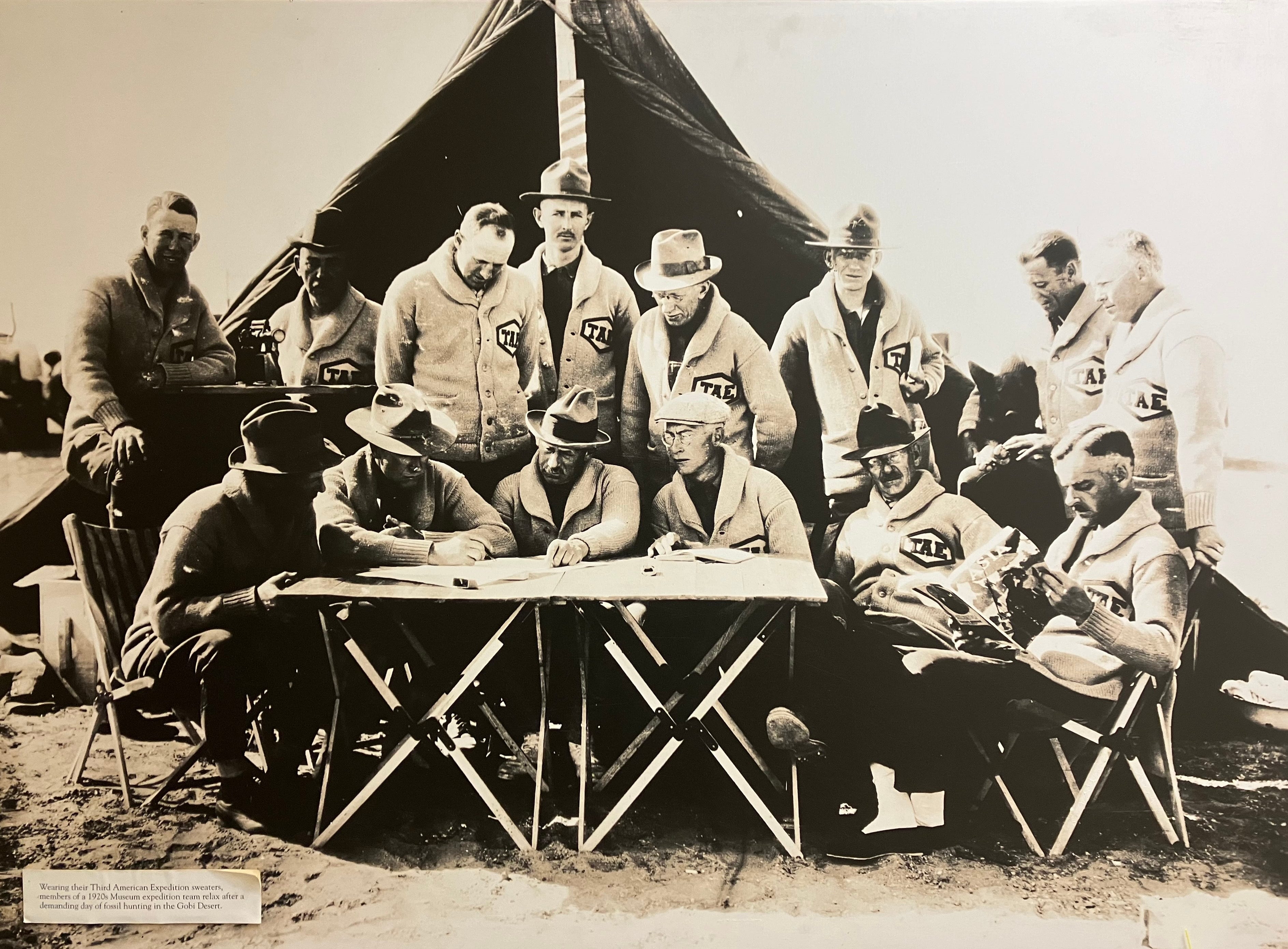
By the late 1800’s the industry of collection was at its height and established museums were funding expeditions all over the globe in search for artifact, stone, and bone. There was a joining of interests in hunting, travel, collecting, geology, conservation, and science, as if all of these were one motion. Patrons of museums would be hired to go out into the world to gather and bring back things to house in the great halls. It was in this period Roy Chapman Andrews would thrive. Born 1884, in Beloit, Wisconsin, as a child, he explored forests, fields, and waters nearby, developing marksmanship skills. He taught himself taxidermy and used funds from this hobby to pay tuition to Beloit College. After graduating, Andrews applied for work at the AMNH. He so much wanted to work there that after being told that there were no openings at his level, Andrews accepted a job as a janitor in the taxidermy department and began collecting specimens for the museum. During the next few years, he worked and studied simultaneously, earning a Master of Arts degree in mammalogy from Columbia University. Andrews also joined The Explorers Club in New York during 1908, four years after its founding.
From 1919-1930 Chapman would spend a great deal of time in China and Mongolia as an explorer for the AMNH in search of bones, fossils, animals, and history. He wrote: “These expeditions went into Mongolia to explore the Gobi Desert, seek the ancestry of man, and study the natural history of the region.” There was a thread of thought in these years that was steeped in racism and cultural superiority. 19th-century race theories often sought to place the origin of the “white” race in Central Asia, Out of Asia as opposed to Out of Africa, and Andrews and these expeditions were not immune to these ideas; a sad impetus, only alongside that came dinosaur fossil discovery.
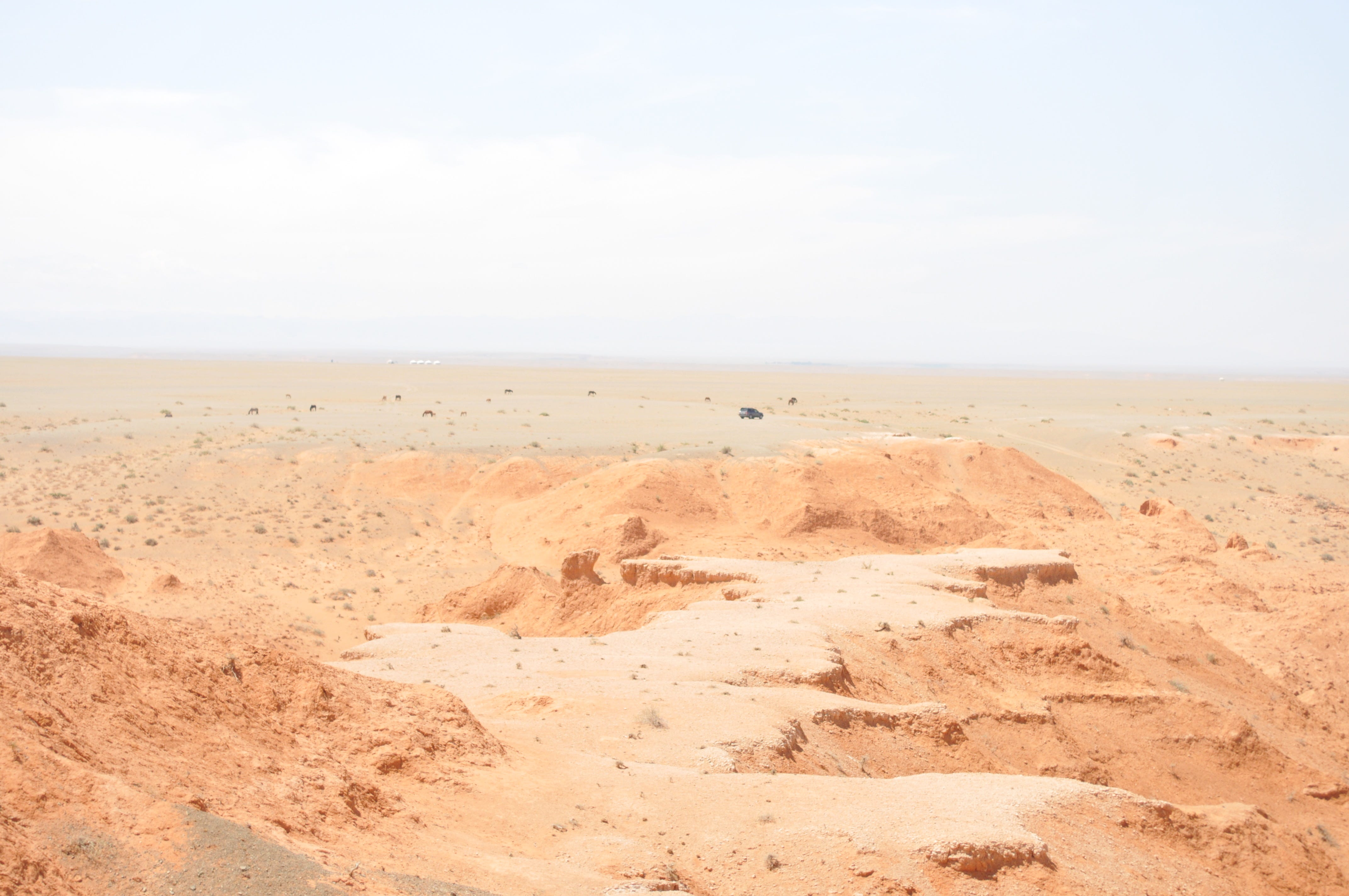
In 1922 the expedition arrived at a place called Bayanzag (also Ulaan Ereg) and later the place would be called the Flaming Cliffs by Andrews and the team. It was a geologically specific region where preserved dinosaur fossils, like a treasure chest, daily flow out of the gobi ground. Tonnes of ancient bone were extracted through the years, packaged, and sent to the American Museum of Natural History. This region is of immense importance in palaeontology and archaeology because they represent one of the world’s most significant fossil sites, offering an unparalleled window into the Late Cretaceous Period (75–71 million years ago). The site is most famous for yielding the first-ever discovered dinosaur eggs in 1923, which fundamentally changed scientific understanding of dinosaur behavior and reproduction, it is where the first Velociraptor was uncovered, and still to this day continues to provide essential data on dinosaur behavior, species diversity, and ecosystem evolution.
By 1930 politics shifted and the curtain began to close. It wasn’t until 1990 when the American Museum of Natural History would be allowed back in for another dig, 60 years later.
Bolor grew up in the 1970’s/80’s Ulaanbaatar. Her father, Chuluun Minjin was a geologist and taught palaeontology at the Mongolian University of Science and Technology. In the 1990’s when the American Museum of Natural History finally was permitted to return to Mongolia, they joined with the Mongolian Academy of Sciences and Bolor’s dad was asked to take part in the expedition. (Years later a shark fossil would be found and named after Bolor’s dad, Minjina tugenensis; the first shark fossil showing they once had bones). Bolor was keen to come along and was tasked with being a cook, though once in the field soaked up knowledge like the dry gobi and forever linking her with the AMNH. By 1997 Bolor had moved to Manhattan to work on a PhD in a joint program with the AMNH and the City University of New York to become the first Mongolian palaeontologist educated in the US and the first Mongolian woman to earn a PhD in palaeontology.
There was a glowing contradiction that continued to bother Bolor, that many of the paleontological finds in the Gobi were credited with scientists coming from afar, those who came and packaged the bones up and shipped them back overseas, that whole communities of Mongolians were seen more as help along the way instead of as equals on a dig; that if you stopped and asked someone on the street in UB about velociraptors they wouldn’t know they were discovered down the road, instead thinking they were from the Americas as that is what the movies looked like. She felt a sense of duty to bring things back, to teach, to establish a center of education and inspiration.
The Victorian age cabinets of curiosities grew into Museums, but the idea of small, movable collections of oddities continued both privately (I have boxes under my bed to attest) as well as use as a tool for education purposes. By the early 1900’s educators debated how best to teach the natural sciences in schools. Outdoor schools popped up in moderate climates, and museums started to send out cases of artifacts on loan, to travel the countryside and inspire generations of scientists. The then newly opened American Museum of Natural History began sending out cabinets of preserved birds, bones, and stones. Movable Museums went from suitcases to converted Ambulances in the 1930’s and by the 1990’s the AMNH had retrofitted buses that would drive around like a vaudeville traveling show teaching astronomy, palaeontology, botany, and anthropology. One can assume that as technology shifted and the internet became established the need for the physical was thought as not necessary, especially given the expense, and in the late 2010’s you could spot the last Dinosaur Bus permanently parked in front of the AMNH, a bus filled with exhibits on Gobi fossils and finds. In 2013 the museum discontinued the program and Bolor noticed an opportunity, a way to start a museum in Mongolia.
Through Bolor’s patience and passions she has a subtle way of convincing people to help her, she inspires. She was able to parlay a deal to get the bus and ship it to Mongolia, and by 2014 it was in the garage of a mechanic in Ulaanbaatar getting ready to drive around the country with the decade long goal of visiting every province in Mongolia. A poetic play given the past 150 years of archeological history and relationships between Mongolia and a museum in New York City.
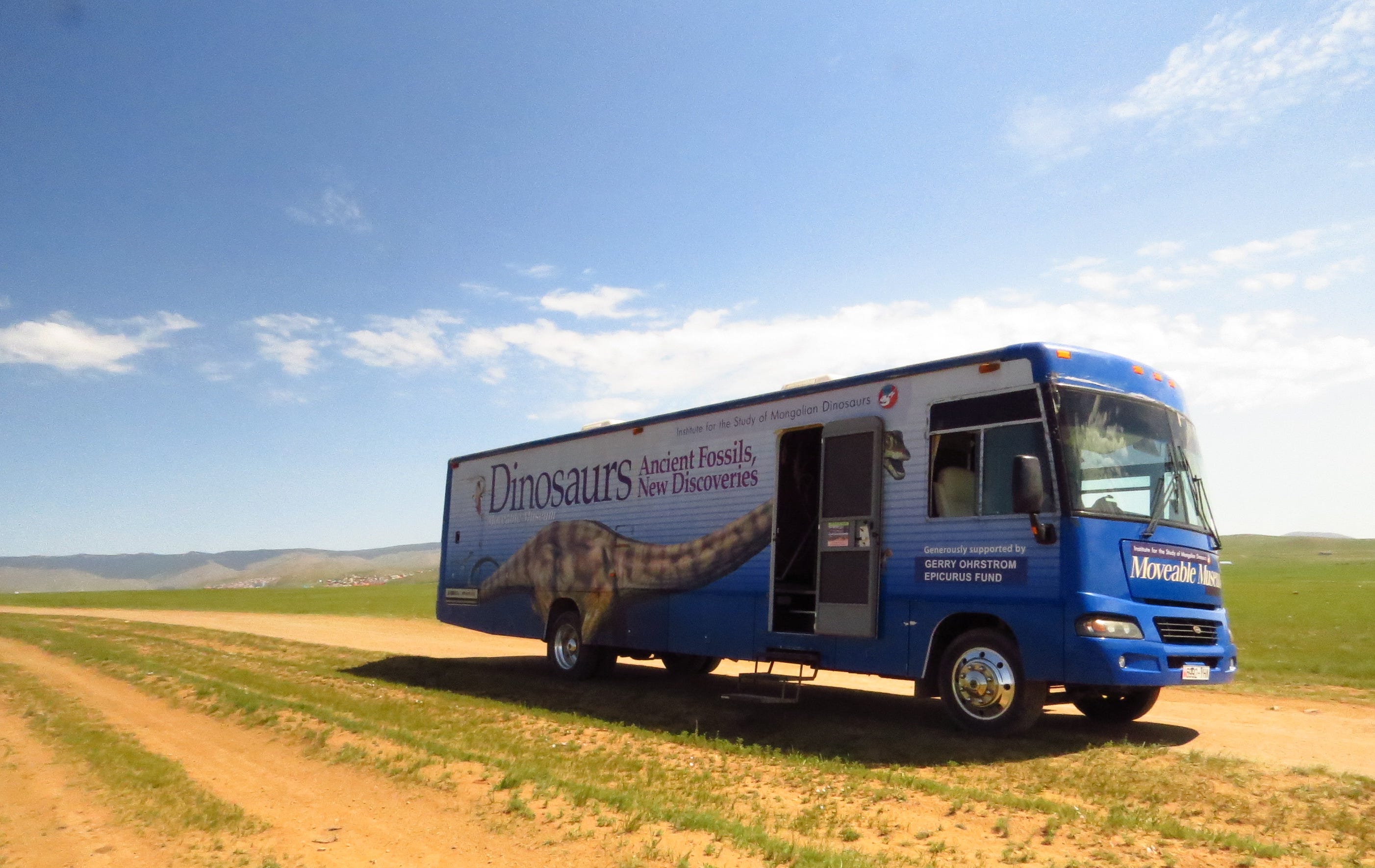
Last summer Bolor and her bus rolled into the final province of a ten year program and the logical next step began, to move from the mobile to the fixed, to build a museum, the first of its kind. The last time I was at the Flaming Cliffs there were a few camels, some wooden stalls selling trinkets, the likes of which you find in the gobi; stones, fossils, old coral necklaces. No sign, no museum, no markings other than the plethora of fossils at ones feet, and there were many. It was hard to believe, my mind just couldn’t grasp that I was stirring the red sand and found old bones, deep time bones, bones from seventy million years ago. Over the past 150 years, some of the world’s most important paleontological discoveries have emerged from this region: the first Velociraptors, the armoured Pinacosaurus, early mammals. These finds have fundamentally reshaped our understanding of life on Earth.
For the past decade, the Mobile Dinosaur Museum has been roaming the provinces of Mongolia, but no permanent structure at the Flaming Cliffs to house new finds and teach generations to come what else might be under the sands and stars, until now.
The plans are drawn, the land set aside, and next week if you are in or near New York City and want to help and be a part of this, to be a patron; on March 20th, on an upper floor at the Explorers Club in New York City, the first day of spring when life laid dormant starts coming back up from below, a gathering will happen chiming in a new chapter to this story. I have been in the room as things began before, and there is a particular magic that occurs with the joining of action and intention. It is a sight to see when dreams come to life.
For more information on tickets to the event you can seek it out here
An incredible project.